‘What are you doing for others?’
‘How can we change things?’

People of color are drowning in fear, stress, despair, and pain due to a system that limits their ability to be truly free. If you were sinking in a system that doesn’t embrace you, how would you react? For people of color and the poor, it is suffocating trying to survive in America.
“People of color face structural barriers when it comes to securing quality housing, healthcare, employment, and education. Racial disparities also permeate the criminal justice system in the United States and undermine its effectiveness. “ (Structural Racism in America) https://www.urban.org/features/structural-racism-america
Changing these systems requires a lot of time and work towards the same common goal. Before we can get to the step of breaking down these barriers piece by piece, we must first underSTAND each other not just STAND each other. We also can’t just skip steps when it comes to engaging each other just to get to compassion.
To truly underSTAND one another, we must be open and willing to be uncomfortable with each other. One must take the right path to foster change and healing. When times are really tough or unexpected situations happen, you can choose to show pity, sympathy, or empathy towards others.
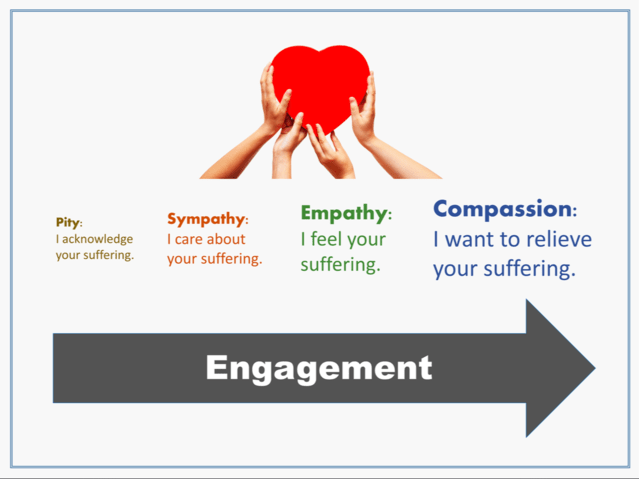
Source: Robert Shelton
Your level of openness, engagement, and strength determines what path you take. The problem is people aren’t being authentic or they are holding on to certain views/perspectives about people of color. On social media and in the news, people of color are shown pity or sympathy more often than empathy. It is easy to hide behind the computer or be in front of the camera and be pretentious. People do these things because they are afraid of being vulnerable and engaging others. To move towards change, we can’t be safe or selfish. There is a cost associated with going further.
‘What are you doing for others?’
Whether the situation is racial disparity or any other difficult situation, choosing the right path that moves us forward, furthers conversation, and leads to all people being free. To be open, engaged, and strong enough to be uncomfortable comes with a cost. Despite the sins of the world and situations people face, Jesus was open and willing to be uncomfortable to help others. Countless times he got in the boat with others no matter what the situation. He empathized and then synchronized with them, thus moving forward. He also paid a cost with love to ensure we weren’t left with just pity or sympathy. It cost him time, resources, his reputation, and ultimately his life. Through his efforts, we are free because of His compassion. How are you using your freedom/privilege? Your privilege can keep you comfortable and blinded to what’s really going on. How can you be engaged enough to have compassion for others?
“For you have been called to live in freedom, my brothers and sisters. But don’t use your freedom to satisfy your sinful nature. Instead, use your freedom to serve one another in love. For the whole law can be summed up in this one command: ‘Love your neighbor as yourself’. But if you are always biting and devouring one another, watch out! Beware of destroying one another.”
Galatians 5:13-15
‘How can we change things?’
We change by being allies toward the same enemies…hate and lies. Here are some guidelines written by Paul Kivel about what you can do as a white ally. There are many allies who have made progress in America from abolitionists to the Freedom Riders. I love how Jane Elliott, a former third-grade teacher, lecturer, and anti-racism activist, used her privilege and platform to empathize with people of color and acted on their behalf (compassion). The blue-eyed, brown-eyed exercise she did with her class the day after Dr. Martin Luther King, Jr. was assassinated showed how it doesn’t take much to affect social justice. We need more allies because in a lot of ways not much has changed since 1968.
GET IN AND LET’S FIGURE THIS OUT…TOGETHER!! ⛵🙏❤


 underSTANDUPlift